Abstract
Religious artefacts such as idols, photographs, and ornate frames hold deep spiritual significance in Indian society. When damaged, faded, or no longer in use, these items often enter water bodies or landfills, creating a unique waste stream that is both culturally sensitive and environmentally impactful. This article reviews the scale of the challenge, the environmental implications of current disposal practices, and highlights innovative circular economy solutions pioneered by organizations such as Sampurnam Seva Foundation (Nashik) and HelpUsGreen (Kanpur). It discusses similar initiatives, explores scaling through urban local body involvement, and offers recommendations to integrate religious waste into formal systems without compromising cultural values.
Keywords: Religious waste; Special Waste; Circular economy; Urban local bodies; Upcycling; Recycling
1. Introduction
Waste generated by religious practices is distinct, carrying sacred associations that make disposal culturally sensitive. Immersion of idols, photographs, and frames in water bodies has been customary in many parts of India. While tradition endows these items with divinity, the increasing use of synthetic materials, chemical paints, laminated surfaces, and plastics in their manufacture has raised environmental concerns (CPCB, 2010). Items once honouring the divine may inadvertently become potential environmental pollutants if not managed appropriately. Managing religious waste responsibly is essential for environmental protection and the circular economy transition.”
Globally, religious waste streams pose similar challenges. Japan’s Hari-Kuyō (Festival of Broken Needles) ceremonially retires sewing tools, while parts of Latin America prefer to bury or store worn religious statues rather than discard them (Oswald, 2019). Given India’s large population and frequent festivals, the scale of waste generation is substantial, presenting both environmental challenges and opportunities for sustainable circular solutions (UNEP, 2021).
The circular economy approach offers a pathway to harmonize respect for tradition with environmental stewardship by closing material loops and creating economic opportunities through upcycling sacred waste.
2. Challenges in Managing Religious Waste in India
2.1 Annual Disposal Volumes
According to Toxics Link, over 100,000 idols are immersed annually in India (Basu, 2013), excluding untracked photographs and frames. Major urban centres face disproportionate waste loads; in Mumbai, the Brihanmumbai Municipal Corporation reports that hundreds of thousands of idols are immersed annually during Ganesh Chaturthi, illustrating the scale of religious waste generated (The Indian Express, 2023). Kolkata immerses around 15,000 Durga idols annually in the Hooghly River (Basu, 2013).
2.2 Composition of Religious Waste
Religious waste comprises a complex mixture of materials reflecting the diverse nature of artefacts used in spiritual practices.
Idols: Idols, which form a significant portion of this waste, are primarily made from Plaster of Paris (PoP) or clay, often reinforced with metals, wood, and thermocol to enhance structural integrity and aesthetic appeal. However, many of these idols are finished with chemical paints that frequently contain toxic heavy metals such as lead, mercury, cadmium, and chromium, posing environmental and health risks during disposal.
Photographs & Frames: Photographs and frames discarded as religious waste add another layer of material complexity. These typically consist of laminated prints for preservation, glass components, wooden frames, various plastics, and metallic foils used for decorative edging or embellishments. These multi-material compositions challenge conventional recycling processes due to the difficulty in separating components.
Associated Materials: In addition to idols and framed photographs, religious waste includes numerous associated materials such as clothes used for draping idols, garlands made from plastic or natural flowers, artificial flowers crafted from synthetic materials, and a variety of other decorative items commonly employed during rituals and ceremonies. The combined presence of biodegradable and non-biodegradable materials necessitates specially tailored waste management solutions that consider both environmental impact and cultural significance.
2.3 Environmental Impacts
The disposal of religious artefacts poses several environmental risks, particularly to water quality. Plaster of Paris (PoP) idols dissolve slowly in water, reducing dissolved oxygen levels critical for aquatic life and releasing harmful chemicals into water bodies (CPCB, 2010). In addition, paints used on idols often contain toxic heavy metals such as lead and cadmium, which leach into rivers and accumulate in aquatic organisms, threatening biodiversity and human health through the food chain (Environmental Science & Technology, 2021). Beyond water pollution, solid waste generated from discarded photographs and frames frequently ends up in open dumps or is incinerated, releasing hazardous emissions and contributing to land and air pollution.
3. Case Studies: Circular Solutions in Action
3.1 Sampurnam Seva Foundation (Nashik)
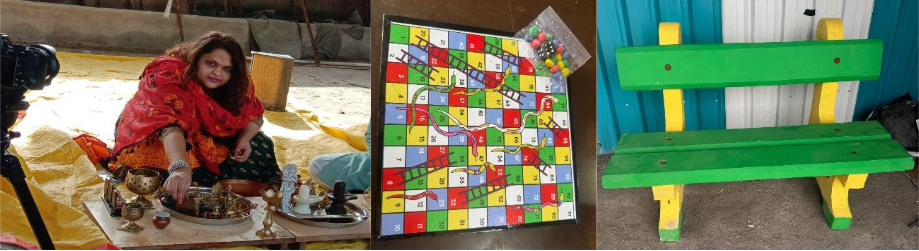
The Sampurnam Seva Foundation was established in 2021 by Advocate Trupti Gaikwad after she was moved by the sight of discarded religious photographs floating in the Godavari River (YourStory, 2022). This inspired the creation of a systematic process for collecting and respectfully repurposing religious artefacts.
The foundation’s operational model involves multiple collection channels, including donations, strategically placed drop-off points, and direct pickups from households and communities. A distinctive feature of the process is the cultural respect maintained by performing a brief Uttar pooja ritual to honour each item before it enters the recycling stream, ensuring adherence to religious sentiments.
The foundation’s processing methods focus on material-specific reuse: Plaster of Paris idols are crushed and combined with cement to produce bird feeders and bowls primarily used for stray animals; wooden frames are creatively transformed into birdhouses and furniture pieces; recovered metals are responsibly sold to recyclers; and plastics are upcycled into toys and small household items. These upcycled products are marketed under the ‘Sampurna’ brand, establishing an identity that links sustainability with cultural values.
As a result of these efforts, Sampurnam has recycled over 350 tons of religious materials and conducted 141 clean-up drives. The initiative notably provides employment and skills training opportunities for women and individuals with autism, promoting inclusive economic empowerment. Revenue generation is sustained through the sale of recycled products and donations.
3.2 HelpUsGreen (Kanpur)
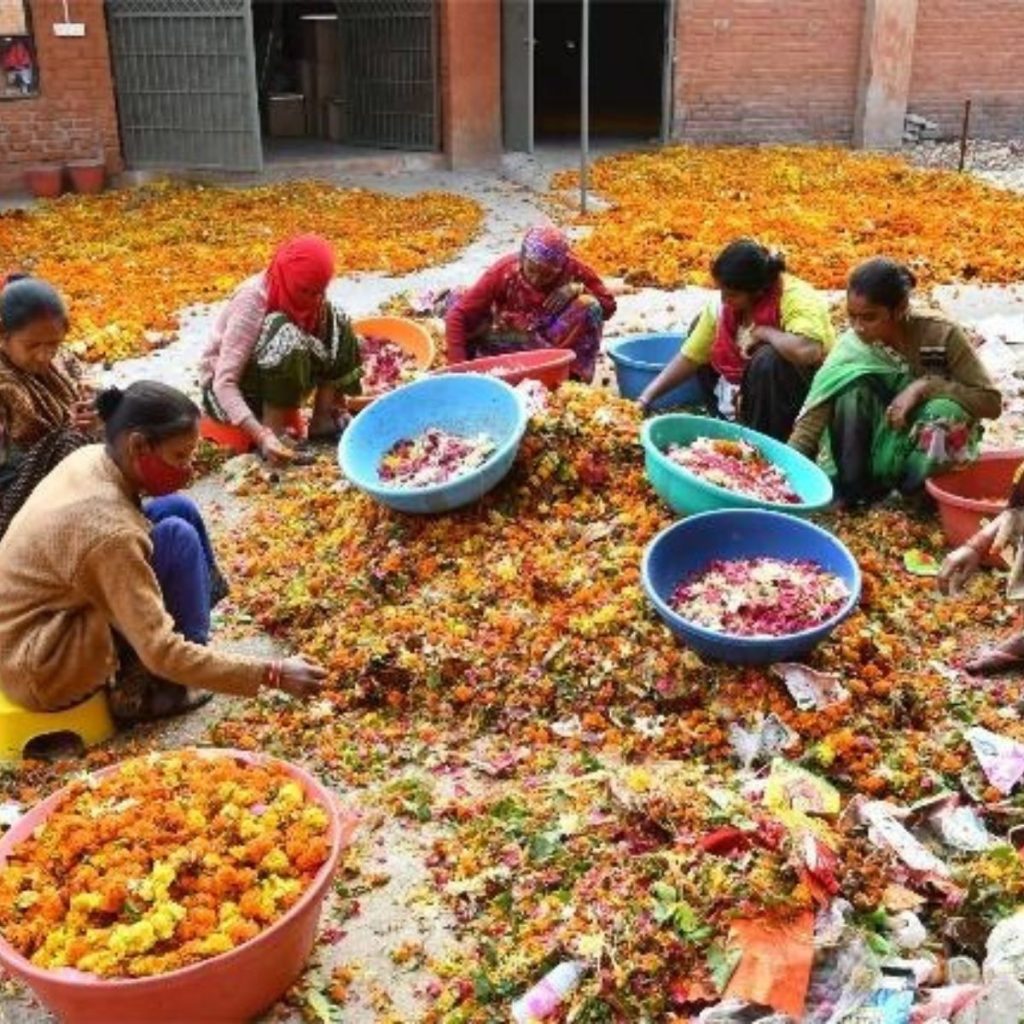
HelpUsGreen was established in 2015 with the mission to prevent temple floral waste from polluting the Ganges River and nearby urban environments (UNEP, 2021). The organization operates a large-scale collection system, gathering approximately 2.5 tonnes of discarded flowers daily from temples, mosques, and other religious sites. These flower petals undergo a cleaning process to remove pesticides and other contaminants, after which they are dried and blended with natural binders to create a variety of sustainable products. These include charcoal-free incense sticks, biodegradable floral foam known as “Florafoam,” organic compost, and seed paper packaging.
By providing steady employment to 23 rural women, HelpUsGreen has contributed to significant socioeconomic benefits, empowering these women with improved incomes and financial independence. Environmentally, the organization has successfully offset 210 metric tonnes of chemical pesticides annually by diverting floral waste from waterways. Its products have found markets both within India and internationally, supported by partnerships with prominent brands. The organization’s impactful work has earned recognition, including designation as a UNEP Young Champion of the Earth and inclusion in Forbes Asia’s 30 Under 30 list.
3.3 Other Initiatives
Several other innovative projects across India exemplify culturally sensitive and circular approaches to religious waste management.
- Murthyshodhana (Bengaluru): The Murthyshodhana initiative in Bengaluru operates through strategically placed drop-off points where communities can responsibly deposit old idols and photographs. This program integrates respectful disposal rituals, ensuring religious sentiments are honoured throughout the process (Sri, 2025).
- Sampoorna (Delhi): In Delhi, the Sampoorna project focuses on upcycling idol clothes into marketable products, empowering women artisans and facilitating skill development while reducing textile waste (Agarwal, 2025).
- Punaravartan Campaign (Pune): The Punaravartan Campaign in Pune recovers clay sludge from idol immersion sites and reutilizes it for new idol production, contributing to material circularity and waste minimization (eCoexist Foundation, n.d.).
These diverse models highlight creative pathways for scalable, community-anchored circular solutions across urban India.
4. Lessons from the Field
Experience from these initiatives reveals several critical success factors that can inform broader replication.
- Cultural Sensitivity: Integrating rituals and honouring religious sentiments before recycling fosters community acceptance and participation.
- Community Engagement: It emerges as essential, with active involvement of local stakeholders building trust and enhancing collection efficiency. Active involvement builds trust and collection efficiency.
- Value Addition: The creation of value addition through upcycled products not only generates revenue but also supports the financial sustainability of these programs.
- Social Inclusion: plays a pivotal role by providing employment and skills training specifically targeting women and marginalized groups, thereby linking environmental objectives with socioeconomic empowerment.
5. Pathways for Scaling and Policy Integration
5.1 Role of Urban Local Bodies (ULBs)
Urban local bodies (ULBs) are central to scaling circular religious waste management solutions. They can facilitate this by providing a designated space near religious sites for collection and processing infrastructure. Collaborative partnerships between ULBs and civil society organizations or NGOs enable efficient post-festival waste recovery, leveraging local networks and expertise. Crucially, integrating religious waste streams into formal municipal solid waste management frameworks ensures systematic handling and monitoring at scale.
5.2 Policy Recommendations
Policy initiatives can significantly accelerate the adoption and impact of circular systems. Mandating the use of eco-immersion tanks can improve material capture and reduce pollution. Extending Extended Producer Responsibility (EPR) frameworks to idol makers could incentivize the use of eco-friendly materials and create take-back systems. Public awareness campaigns are essential to educate citizens on the environmental consequences of traditional disposal methods and to promote the adoption of sustainable alternatives.
5.3 Economic Incentives
To catalyze operational viability, governments could offer grants dedicated to establishing recycling and upcycling facilities specializing in religious waste. Tax benefits aimed at donors contributing to registered religious waste management NGOs would encourage philanthropy and investment in this niche sector. Such financial mechanisms can underpin a sustainable ecosystem for sacred waste circularity.
6. Global Parallels and Opportunities
The challenges and solutions relating to religious waste management are not unique to India; global parallels enrich the understanding and offer opportunities for cross-cultural learning.
- Japan: In Japan, Kuyō ceremonies respectfully honor and retire worn tools and religious paraphernalia through temple-led disposal practices, exemplifying a model that blends reverence with material recovery (Oswald, 2019).
- Philippines: In the Philippines, community-led recycling initiatives effectively divert waste generated from festival decorations, mirroring approaches found in Indian contexts (UNEP, 2021).
These examples illustrate the potential for cultural exchange and adaptation of best practices that integrate tradition with sustainability, fostering a global movement towards circularity in culturally significant waste streams.
7. Conclusion
Religious artefact waste embodies both an environmental challenge and an opportunity. Unmanaged, it fuels pollution and resource depletion. Managed via circular economy principles, it can yield livelihoods, preserve culture, and regenerate ecosystems. The efforts of Sampurnam Seva Foundation, HelpUsGreen, and similar NGOs exemplify sustainable, culturally respectful solutions. Scaling such solutions through ULB support, policy backing, and public engagement can transform this neglected waste stream into a regenerative sector.
Acknowledgements:
The author thanks Advocate Trupti Gaikwad and Sampurnam Seva Foundation for their support and valuable insights.

Founder & Managing Director
Cipher Environmental Solutions LLP, Thane