
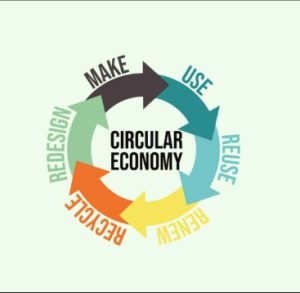
The circular economy is no longer a niche concept but a global policy imperative. Nations and corporations are shifting from linear “take-make-dispose” models to circular systems that design out waste, regenerate natural systems, and keep materials in use. In this journal, I reflect on key global circularity policies, Japan’s industrial approach, and how MITS can play a pivotal role in advancing circular economy education, research, and industry partnerships.
Global Circular Economy Policy Landscape
Circular economy frameworks are being integrated into national policies worldwide:
- European Union – Circular Economy Action Plan (2020) A comprehensive policy package focusing on sustainable product design, waste reduction, and empowering consumers. The EU’s Ecodesign Directive and Digital Product Passport initiative are benchmarks for regulatory innovation.
- Japan – Sound Material-Cycle Society (2000 onward) Japan’s 3R Initiative (Reduce, Reuse, Recycle) is deeply embedded in industrial and social systems. The Circular Economy Vision 2020 and Plastic Resource Circulation Strategy demonstrate Japan’s commitment to closing material loops, especially in electronics, automotive, and construction sectors.
- India – Resource Efficiency and Circular Economy Strategy (2022) NITI Aayog’s national strategy emphasizes sectoral action plans, extended producer responsibility (EPR), and public-private partnerships. India’s Swachh Bharat Mission and Plastic Waste Management Rules reflect growing policy momentum.
- United States – National Recycling Strategy (2021) Focus on improving domestic recycling infrastructure, enhancing markets for recycled commodities, and reducing contamination in recycling streams.
- China – Circular Economy Promotion Law (2008, updated) China has integrated circular economy principles into its five-year plans, focusing on industrial parks, eco-design, and remanufacturing.
Japan’s Industrial Leadership in Circularity
Japan’s success in circularity is not accidental but the result of systemic integration of policy, corporate culture, and social responsibility:
- Kaizen & Monozukuri: The ethos of continuous improvement and excellence in manufacturing reduces waste at the source.
- Eco-Town Initiatives: Industrial symbiosis parks, such as those in Kawasaki and Kitakyushu, where waste from one process becomes input for another.
- Legislative Frameworks: The Home Appliance Recycling Law and Vehicle Recycling Law enforce producer responsibility and achieve recovery rates exceeding 95%.
- Corporate Ambition: Companies like Panasonic, Toyota, and Toshiba have set ambitious targets for zero waste, renewable energy, and circular product design.
This integrated model offers a blueprint for other nations, especially emerging economies seeking to balance industrial growth with sustainability.
Implications for Global Stakeholders
The Japanese experience, combined with evolving global policies, offers several actionable insights for diverse stakeholders:
For Policymakers:
- Develop Hybrid Regulatory Models: Combine top-down regulations (like Japan’s recycling laws) with incentive-based mechanisms to encourage innovation.
- Foster Industrial Symbiosis Zones: Create policy frameworks and infrastructure to support eco-industrial parks.
- Align National and International Standards: Harmonize circular economy metrics and reporting to facilitate cross-border collaboration and trade.
For Industry Leaders:
- Embed Circularity in Corporate Strategy: Move beyond compliance to integrate circular design, reverse logistics, and material recovery into core business models.
- Invest in Cross-Sector Partnerships: Collaborate with academia, startups, and even competitors to develop scalable circular solutions.
- Leverage Digital Tools: Implement blockchain for traceability, IoT for resource tracking, and AI for waste stream optimization.
For Academia and Research Institutions:
- Develop Interdisciplinary Programs: Create curricula that blend engineering, economics, policy, and design thinking to prepare the next generation of circular economy professionals.
- Act as Neutral Knowledge Hubs: Facilitate multi-stakeholder dialogues, pilot projects, and independent assessment of circular initiatives.
- Translate Research into Practice: Partner with industry to test and scale innovations, particularly in regions with high resource vulnerability.
Conclusion: Toward a Globally Integrated Circular Future
The circular economy represents a transformative paradigm that transcends national borders and industrial sectors. Japan’s model demonstrates that success lies in the integration of policy, corporate action, and cultural adoption. However, no single nation can circularize in isolation.
The path forward requires collaborative governance, shared innovation, and a commitment to equitable transition. By learning from frontrunners like Japan and adapting those lessons to local contexts, global stakeholders—governments, industries, academia, and civil society—can co-create a resilient, resource-smart future.
The challenge is substantial, but so is the opportunity: to redefine growth, redesign systems, and regenerate our relationship with the planet. The time for isolated initiatives is over; the era of global circular collaboration has begun.

Assistant Director Industry Relations
MITS University