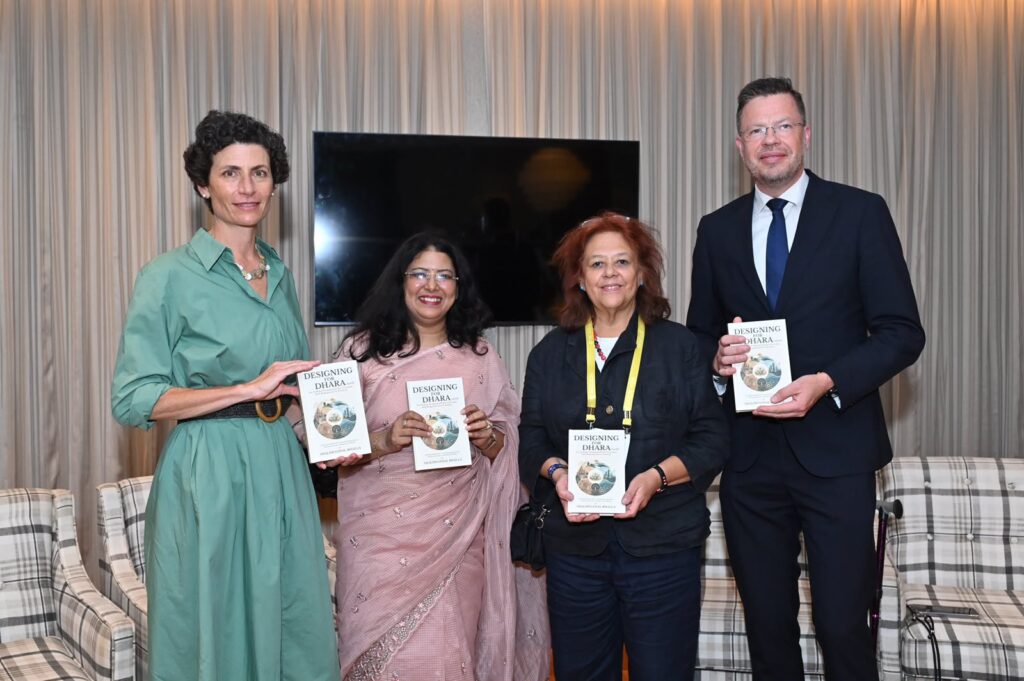

Designing for Dhara: An Indian Framework for Circular and Regenerative Futures
A Field Guide for the Transformation of Cities, Infrastructure, Industry & Skills
The book presents a timely and necessary rethinking of the circular economy through the lens of design, culture, and context, positioning India at the forefront of shaping regenerative development pathways. Globally, the circular economy discourse has evolved largely through Western frameworks, focusing on resource efficiency, waste reduction, and industrial redesign. While these principles are critical, they often remain technocratic and system-driven, with limited integration of cultural values, behavioural dimensions, and community-led practices, elements that are deeply embedded in Indian society.
This book introduces a unique and original concept: “Designing for Dhara” (Dhara meaning Earth), which builds on global circular design principles while grounding them in India’s traditional ethos of balance with nature, frugality, and collective responsibility. It frames it as:
- a design philosophy rooted in respect for natural systems,
- a behavioural movement aligned with initiatives like Mission LiFE,
- and a systems approach that integrates cities, industry, education, and governance.
By merging Western circular design frameworks with India’s civilizational wisdom and contemporary realities, the book offers a hybrid model that is both globally relevant and locally actionable. It demonstrates how India can move from linear growth to regenerative development, not by replicating existing models, but by designing its own.
The book is structured as a practical guide for policymakers, practitioners, educators, and industry leaders, supported by field experiences, global case studies, and actionable frameworks. It positions India’s transition toward 2047 as an opportunity to create regenerative cities, circular livelihoods, and systems that enhance both economic prosperity and ecological resilience. At a time when the world is seeking scalable and inclusive sustainability solutions, Designing for Dhara offers a distinct Indian contribution to the global circular economy narrative—one that integrates design, culture, and responsibility toward the Earth.
About the Book
Designing for Dhara reimagines the circular economy through the lens of Indian culture, design, and sustainability. Moving beyond purely technical models, the book introduces Designing for Dhara (Earth) as a framework rooted in balance with nature, collective responsibility, mindful consumption, and regenerative development.
Drawing from policy insights, global case studies, Indian knowledge systems, and practical examples, the book offers pathways for transforming cities, infrastructure, industry, skills, and livelihoods. It positions India and the Global South not merely as adopters of circular economy models, but as contributors to a new development imagination.
Why This Conversation Matters
The world is searching for new models of growth that can address climate change, waste, resource scarcity, biodiversity loss, and social inequity. Circular economy is no longer only about recycling; it is about redesigning systems so that materials remain in use, waste is eliminated, and nature is regenerated. ICCE’s own circular economy framing reflects these principles: eliminating waste and pollution, circulating products and materials, and regenerating nature.
Designing for Dhara adds an Indian and Global South perspective to this global transition. It asks: how can India design development pathways that are modern, inclusive, circular, and deeply respectful of ecological balance?
About the Author
Shalini Goyal Bhalla is one of India’s leading voices on circular economy and regenerative development. A circular economist, strategist, and institution builder, she has been at the forefront of advancing India’s transition towards resource-efficient, inclusive, and future-ready systems.
As Founder and Managing Director of the International Council for Circular Economy, she works across policy, industry, academia, and international platforms to accelerate circular solutions for India and the Global South. Her work bridges systems thinking, design, sustainability, climate action, livelihoods, and innovation, helping governments, businesses, and communities move from linear growth models to regenerative pathways.
Through her writing, research, advocacy, and public engagement, Shalini continues to shape conversations on how cities, infrastructure, industry, skills, and society can be redesigned for a more balanced and regenerative future.