ICCE Advances Circular Textiles Agenda at Bharat Tex 2026; Releases 10th Edition of Journal on Circular Economy and Launches Bharat SUTRA
Bharat SUTRA – Sustainable Upcycling and Textile Regeneration Accelerator – emerges as the implementation platform to translate industry dialogue into capacity building, technology adoption and cluster-level action.
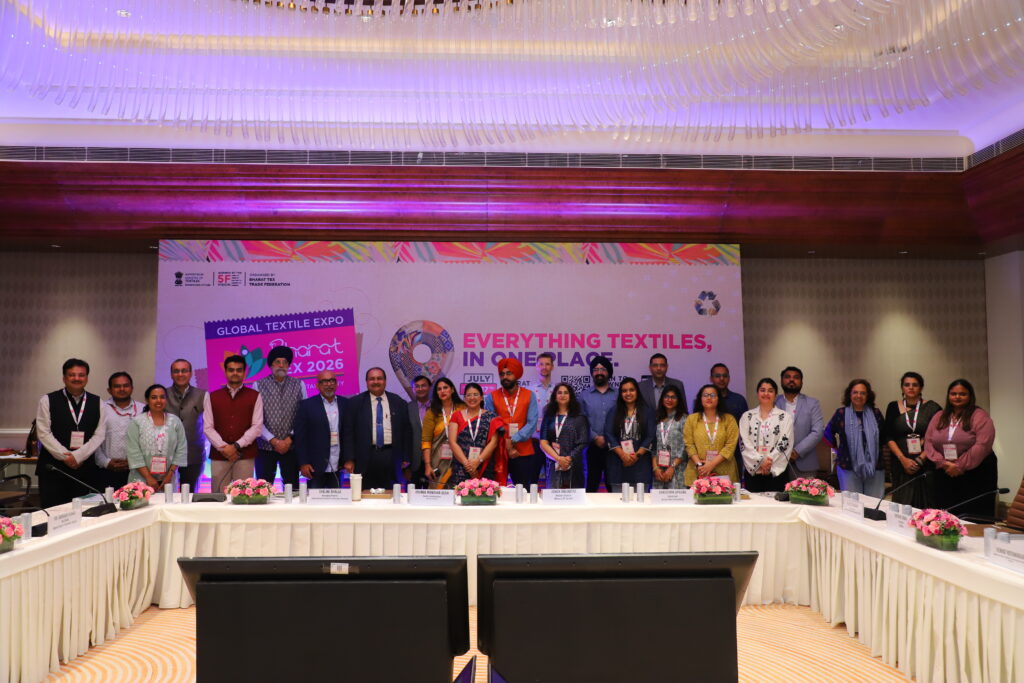
New Delhi, 16 July 2026: The International Council for Circular Economy (ICCE) strengthened the conversation on India’s transition towards circular textiles at Bharat Tex 2026, bringing together policy, industry, academia, standards bodies, recyclers, MSMEs, finance and international experts for a focused policy–industry dialogue on “Circular Textiles: From Dialogue to Deployment”.
The closed-door co-creation roundtable examined how India’s textile ecosystem can move beyond sustainability commitments towards practical implementation. Discussions spanned circular business models, textile recovery and recycling, standards and traceability, Digital Product Passports (DPPs), skills, technology adoption, finance and the institutional support required for MSMEs and textile clusters. The roundtable, convened by ICCE in partnership with Chase Advisors, included representatives from manufacturers and brands, MSME and recycling enterprises, BIS, NIFT, NITRA, industry associations, academia, financial and policy specialists and international experts. Two acceleration sprints explored circular business models and the policy, finance, standards, skills and institutional enablers needed to move solutions towards deployment.
INDUSTRY DIALOGUE IDENTIFIES PRIORITIES FOR ACTION
A live stakeholder consultation conducted during the session highlighted a clear set of implementation priorities for the Indian textile sector. Participants identified reverse value chains, collection and sorting systems, MSME handholding, affordable technology, capital and technical capability, compliance readiness and stronger market demand as critical to making circular business models commercially viable. The discussion also highlighted the need for greater practical support to prepare MSMEs and exporters for emerging requirements around traceability, standards, ESPR and Digital Product Passports. The deliberations reinforced the need to look at circularity across the complete textile value chain—from fibre and design to use, repair, collection, sorting and fibre recovery. They also positioned standards, traceability and DPP preparedness increasingly as issues of trade and competitiveness, alongside their environmental relevance.
A 5C framework emerged from the discussions:
Conscious Consumption
Circular Design
Collaborative Action
Traceability
Commercial Viability
ICCE RELEASES 10TH EDITION OF JOURNAL ON CIRCULAR ECONOMY
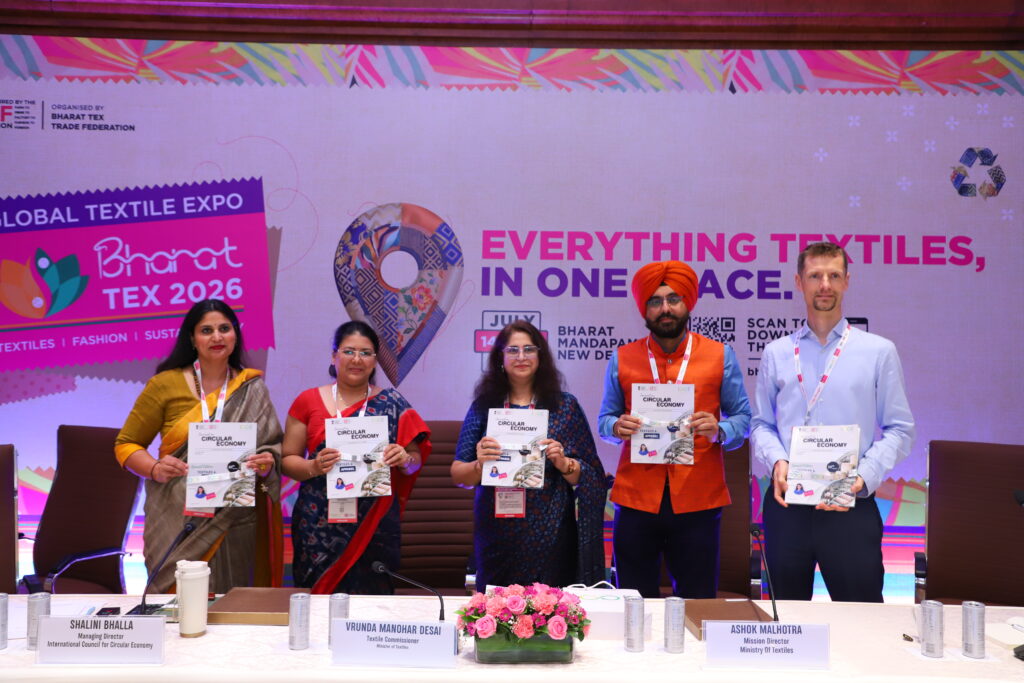
Marking another milestone at Bharat Tex 2026, ICCE also released the 10th edition of its Journal on Circular Economy, continuing its effort to build and disseminate knowledge on India’s circular economy transition. The journal provides a platform for research, practitioner perspectives and emerging ideas around circular economy and complements ICCE’s broader focus on translating knowledge into policy dialogue, skills, business solutions and implementation. Its release at Bharat Tex reflected the evolving nature of the circular economy conversation in India—from building awareness and knowledge to developing sector-specific pathways capable of delivering measurable impact.
FROM DIALOGUE TO DEPLOYMENT: BHARAT SUTRA
A key outcome of the Bharat Tex engagement was the development of BHARAT SUTRA – Sustainable Upcycling and Textile Regeneration Accelerator as the next-stage implementation mechanism for ICCE’s work on circular textiles. Bharat SUTRA has been conceptualised as a 24-month, industry-facing implementation platform that will work particularly with MSMEs and textile clusters to translate circular economy and market priorities into practical capability, technology adoption and demonstrable solutions.
The Accelerator will focus on four interconnected areas:
- Capacity Building – cluster programmes, expert masterclasses and train-the-trainer initiatives
- Compliance & Knowledge Readiness – practical support around standards, certification, traceability and Digital Product Passports;
- Affordable Technology Adoption – identifying, demonstrating and supporting the uptake of appropriate circular and resource-efficient solutions; and
- Deployment & Scale – enterprise diagnostics, industry and cluster pilots, evidence generation and pathways for replication.
The proposed programme will move progressively from mobilisation and readiness-building to technology demonstration, industry pilots, evaluation and replication. Over the implementation period, Bharat SUTRA envisages developing documented industry or cluster pilots, practical tools for MSME circularity and traceability readiness, investible circular-textile solutions and evidence-led pathways for scale. “The next phase of circularity has to be about implementation.”

Shalini Goyal Bhalla, Managing Director, ICCE, said:
“Bharat Tex gave us an important opportunity to listen to industry and understand where the real implementation gaps lie. The message was clear: industry needs more than awareness. It needs skills, handholding, affordable technology, market linkages and demonstrable business cases. Bharat SUTRA is our response to that need—a platform designed to take circular textiles from dialogue to deployment.” She added:
“The release of the 10th edition of our Journal on Circular Economy represents the knowledge journey ICCE has built over the years. Bharat SUTRA represents its next evolution—taking that knowledge into companies, clusters and practical implementation.”
BUILDING INDIA’S CIRCULAR TEXTILE ECOSYSTEM
Through Bharat SUTRA, ICCE intends to convene textile companies, MSMEs, clusters, technology providers, academic and research institutions, skill organisations, finance, innovators and global knowledge partners around concrete implementation opportunities. The ambition is to build a platform where knowledge leads to capability, capability leads to pilots, and pilots generate the evidence required for scale. With the 10th edition of its Journal marking a decade of knowledge-building milestones and Bharat SUTRA creating the pathway towards implementation, ICCE’s engagement at Bharat Tex 2026 signals a wider shift in India’s circular textile journey: