From Campus Operations to Circular Learning
Measure. Improve. Regenerate.
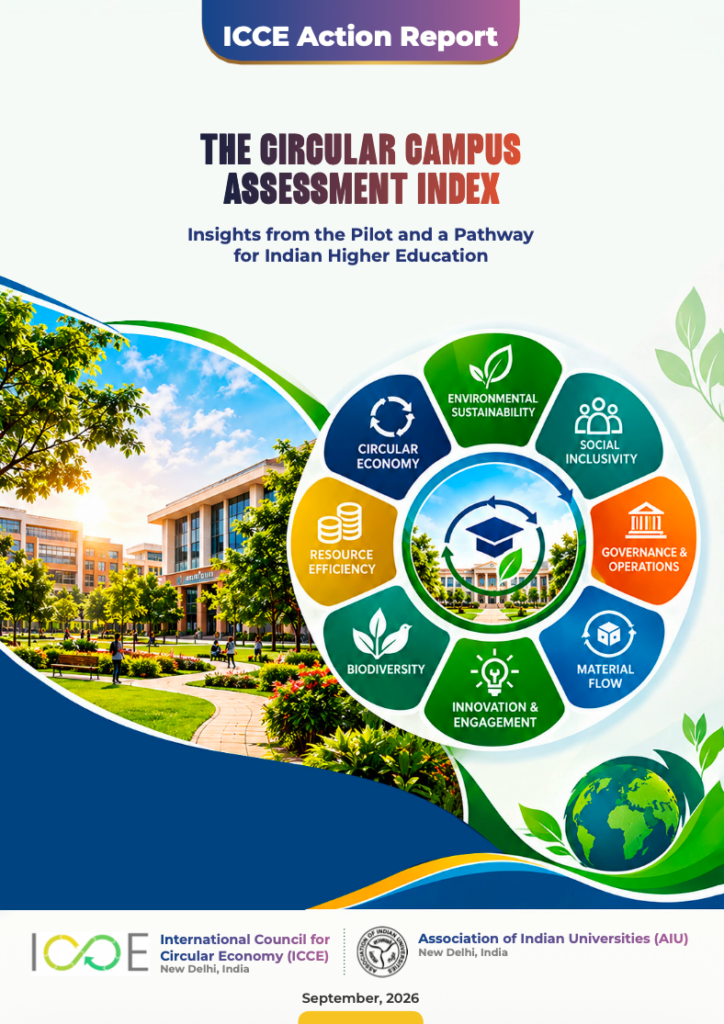
The Circular Campus Framework enables higher education institutions to understand how natural resources, including water, energy and materials move through their campuses—and to transform these systems into opportunities for resource efficiency, decarbonisation, innovation, green skills and experiential learning.
Designed for the diversity of Indian universities and colleges, the framework combines a transparent assessment methodology, an easy-to-use reporting system, institutional benchmarking and a practical improvement roadmap.
Data-driven | Improvement-oriented | Designed to complement existing frameworks
Universities do more than educate—they shape how the future is imagined and built.
Higher education institutions function like small cities. They consume electricity and water, procure food, paper, electronics, chemicals and construction materials, operate buildings and transport systems, manage waste, and influence the behaviour of thousands of students and staff.
Yet many institutions do not have an integrated view of these resource flows. Sustainability initiatives often remain scattered across departments, while valuable campus systems—solar plants, wastewater treatment facilities, biodiversity areas, composting units and repair initiatives—remain disconnected from teaching and research.
The Circular Campus Framework helps institutions move:
- from isolated projects to connected systems;
- from estimates to credible data;
- from waste management to material circularity;
- from environmental awareness to measurable behavioural change;
- from classroom-only learning to hands-on experience; and
- from sustainability reporting to long-term institutional transformation.
A Circular Campus is a higher education institution that systematically applies circular economy principles across its operations, infrastructure, procurement, natural assets and academic programmes.
It seeks to:
- reduce avoidable resource consumption;
- extend the useful life of products and infrastructure;
- reuse water and materials;
- repair and refurbish assets;
- recover value from waste;
- regenerate biodiversity and natural systems;
- reduce greenhouse-gas emissions; and
- equip students with the skills required for green jobs and a circular economy.
A Circular Campus is not defined by one solar installation, plantation drive or waste-management activity. It is defined by how effectively its different systems are connected and continuously improved.
What Makes the Circular Campus Framework Different?
- Systems—not standalone projects: The framework examines how energy, water, waste, procurement, biodiversity and education connect with one another.
- Procurement-to-waste material flows: Institutions track what enters the campus as well as what leaves it. This allows them to identify avoidable purchasing, reuse opportunities, hidden costs and unaccounted Scope 3 impacts.
- Operational performance plus institutional capability: The assessment considers both current environmental performance and the institution’s ability to improve through governance, skills, student participation and data systems.
- Fair comparison through normalisation: helps avoid unfair comparisons between a compact urban college and a large residential university. Indicators are normalised using variables such as:
- students and staff;
- built-up area;
- total land area;
- hostel population;
- meals served;
- laboratory count; and
- campus type.
5. Evidence-based but participation-friendly: The framework draws upon utility bills, invoices, operating logs, surveys, curricula and institutional records. It avoids unnecessary data complexity while maintaining transparency and verifiability.
6. Improvement before ranking: Each institution receives not only a score but also:
- pillar-wise results;
- data-readiness status;
- identified gaps;
- priority actions;
- peer comparisons; and
- a pathway to the next certification level.
7. Designed to complement existing systems: CCF is designed to support data readiness and institutional improvement relevant to NIRF Sustainability, NAAC, the SDGs, NEP 2020 and international university sustainability rankings. It does not seek to replace these systems.
Tested across contrasting Indian campus contexts
During 2025–26, ICCE piloted the Circular Campus framework across four diverse higher education institutions:
- IIT Dharwad, Karnataka;
- Guru Gobind Singh Indraprastha University, Delhi;
- Uttaranchal University, Uttarakhand; and
- MET Institute of Management, Mumbai.
The pilot covered energy, water, waste, procurement, biodiversity and Scope 3 emissions and produced institution-specific baselines and improvement priorities. It also demonstrated that strengths in one area—such as renewable energy—do not automatically translate into complete campus circularity when material, procurement, commuting or skills data remain untracked.
The pilot confirmed four common needs across institutions:
- reliable and continuous sustainability data;
- integrated mapping of campus resource flows;
- stronger procurement and Scope 3 reporting;
- and deliberate connection between campus operations and academic learning.
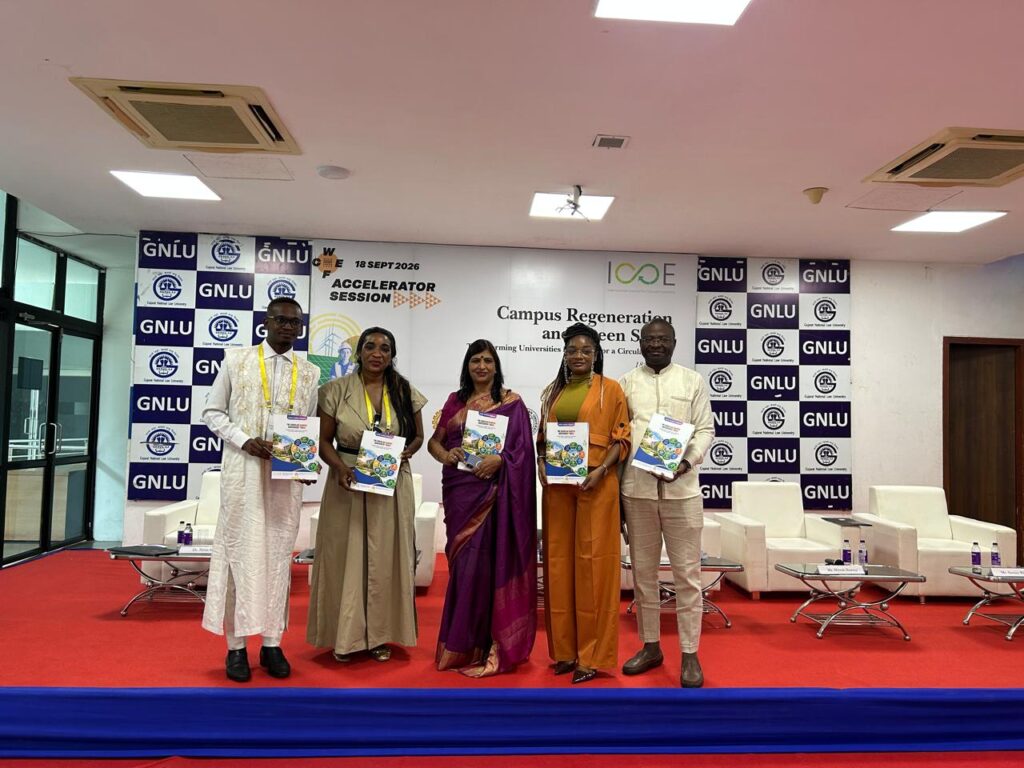
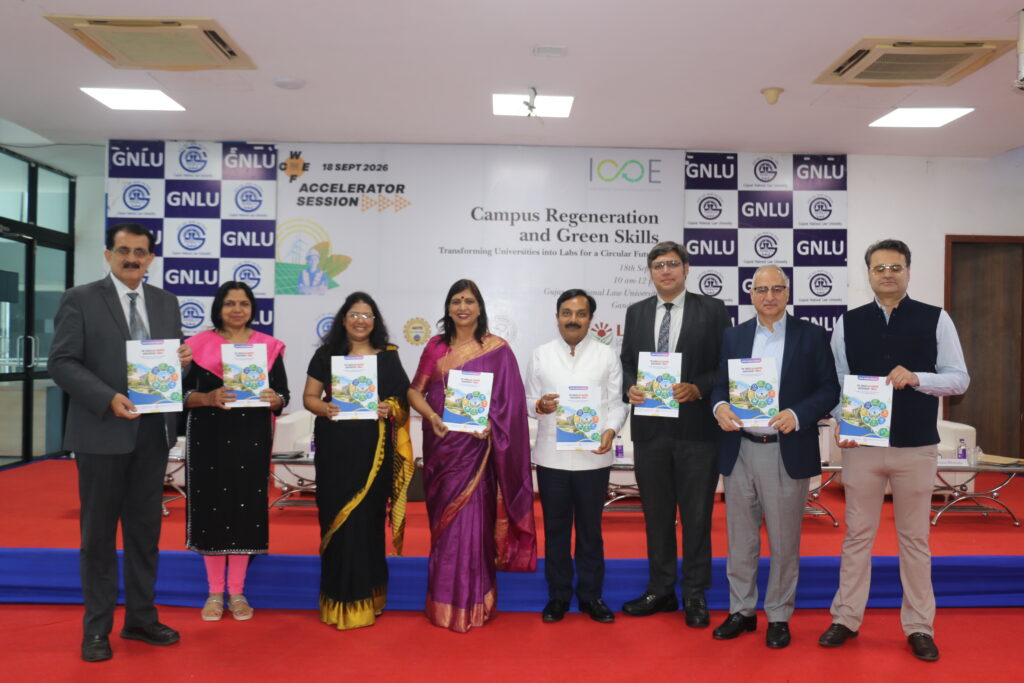
Launched in Gandhinagar during WCEF2026
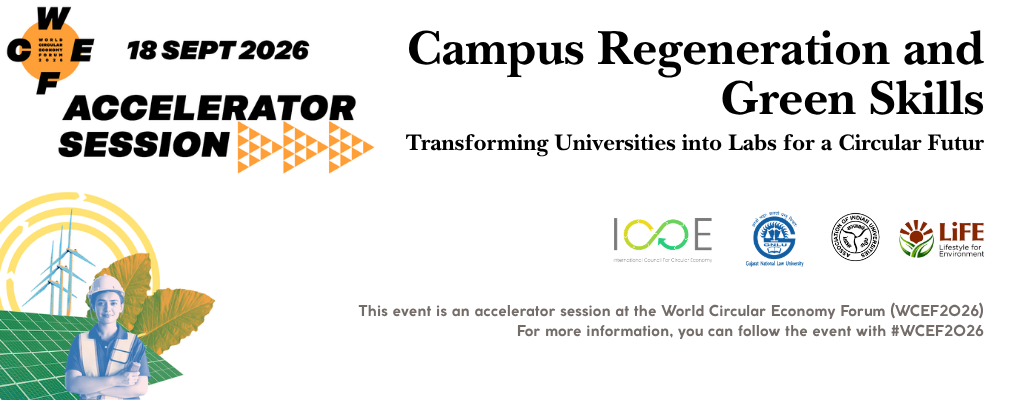
The Circular Campus Framework was introduced in Gandhinagar during WCEF2026, held from 15–18 September 2026. The tenth edition of WCEF was the first hosted in South Asia and brought global attention to scalable circular-economy solutions, resource efficiency and the transition from isolated waste-management interventions to system-level circularity.
ICCE rolled out the first phase for a structured circular campus, beginning with a lead university partner and a cohort of interested institutions from the states of Gujarat, Tamil Nadu and Cameroon.
Make Your Campus a Living Laboratory
Join a national community of universities and colleges working to reduce resource use, strengthen institutional resilience, create green skills and prepare students for the circular economy.