Building India's workforce with Green Skills
From Waste Management to Resource Management
Electronic waste represents one of the most important intersections between the circular economy, green jobs and resource security. Discarded electrical and electronic equipment contains plastics, ferrous and non-ferrous metals, precious metals and strategically important materials. When improperly handled, e-waste creates serious environmental and occupational-health risks. When professionally collected, dismantled, repaired, refurbished and recycled, however, it becomes an important source of secondary raw materials. This shift from seeing discarded electronics as “waste” to recognising them as a reservoir of resourcesis fundamental to ICCE’s approach. The emerging circular economy requires a new generation of designers and technicians who understand not only how products work but also what happens to products and materials after their first useful life.
E-Waste and Circular Resource Management
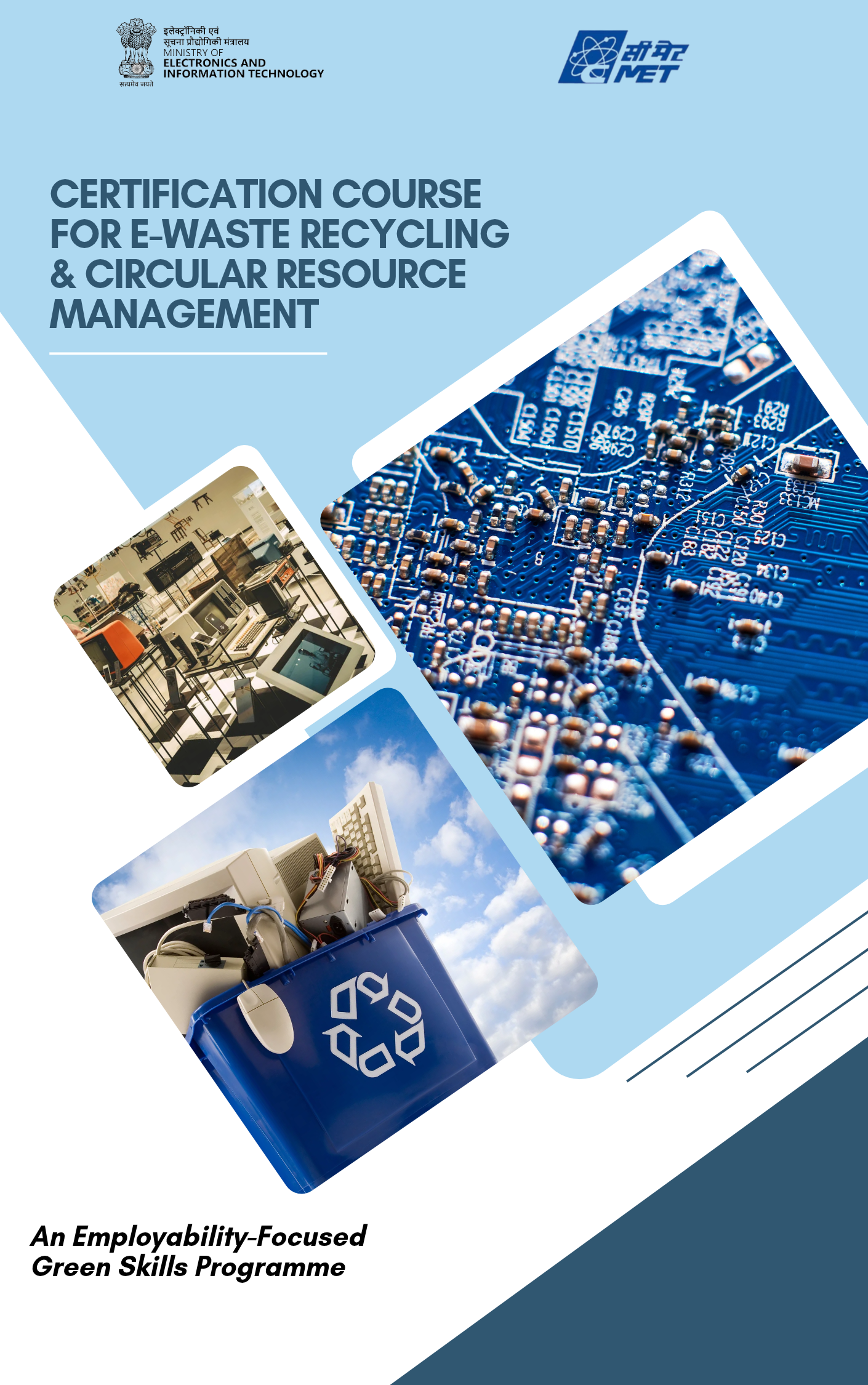
ICCE has developed a comprehensive theory and practical curriculum for Industrial Training Institutes in India on E-Waste Recycling and Circular Resource Management. Conceived as an employability-focused green-skills programme, the curriculum translates circular-economy principles into competencies that can be understood and applied by students entering technical and vocational professions. Rather than treating e-waste management as a standalone environmental subject, the curriculum follows the complete journey of an electronic product—from use and end-of-life management to repair, dismantling, recycling and resource recovery. Students are introduced to areas including:
- electrical and electronic equipment and different categories of e-waste;
- material composition of electronic products;
- valuable, precious and hazardous materials contained in e-waste;
- environmental and occupational-health implications of unsafe e-waste handling;
- India’s e-waste regulatory framework and Extended Producer Responsibility;
- safe collection, segregation, storage and transportation;
- identification and dismantling of electrical and electronic equipment;
- repair, reuse, refurbishment and life-extension opportunities;
- recycling processes and material recovery;
- responsible handling of batteries and other sensitive components;
- formal and informal e-waste value chains;
- circular business models and entrepreneurship; and
- employment and livelihood pathways emerging from the circular economy.
The programme combines theory with practical learning, helping students connect classroom concepts with activities that occur within actual e-waste and electronics value chains. This is important because circularity cannot be delivered through policy alone. Products have to be inspected, repaired, dismantled, sorted, processed and returned to productive use—and each of these activities requires skilled people.
Creating a New Generation of Green Technicians
As India expands manufacturing, electronics consumption, renewable energy systems, electric mobility and digital infrastructure, the demand for technical workers capable of managing materials across their lifecycle will also increase. ICCE therefore sees vocational institutions, particularly ITIs, as an important part of India’s circular-economy infrastructure. A student trained in circular resource management can potentially participate across several emerging occupational pathways, including:
- Repair and Product-Life Extension: Diagnosing products, replacing components and keeping equipment in productive use for longer.
- Refurbishment and Remanufacturing: Restoring products and components so that their economic value can be retained.
- Collection and Reverse Logistics: Enabling discarded products to move from consumers and businesses into authorised circular value chains.
- Dismantling and Material Segregation: Safely separating components and material streams for downstream recovery.
- Recycling and Resource Recovery: Supporting formal recycling operations and recovery of metals and other secondary materials.
- Circular Entrepreneurship: Building businesses around repair, collection, refurbishment, resale, recycling and resource recovery.
E-Waste Skills with India’s National Critical Mineral Mission
ICCE’s work on e-waste skilling has acquired even greater strategic relevance with the launch of India’s National Critical Mineral Mission (NCMM). The Government of India approved the NCMM in January 2025 to develop resilient critical-mineral value chains covering exploration, mining, processing and recovery from end-of-life products. Recycling and workforce development are explicit elements of the Mission. The NCMM envisages creating 10,000 skilled professionals across the critical-mineral value chain, including recycling, and seeks to strengthen circular recovery of minerals from secondary sources. This creates an important connection between vocational education and national resource security. Electronic waste is increasingly recognised as a secondary source of strategically important materials. In September 2025, the Government approved a ₹1,500-crore Critical Mineral Recycling Incentive Scheme under the NCMM specifically to develop capacity for recovering critical minerals from secondary sources including e-waste and spent lithium-ion batteries.
By April 2026, 58 entities had been declared eligible under the scheme, with proposed projects spanning battery recycling, e-waste processing and recovery from other waste streams. This emerging infrastructure will need trained people. Machines, recycling plants and investments alone cannot create an effective secondary-material ecosystem. India will also require technicians who understand:
- safe dismantling;
- material identification and segregation;
- battery handling;
- pre-processing;
- recovery pathways;
- resource efficiency;
- environmental compliance; and
- circular material flows.
ICCE’s ITI-level programme therefore sits at an important intersection of three national priorities:
Skilling India → Circular Economy → Critical Mineral Security
It offers a pathway through which India’s vocational-education ecosystem can begin developing the shop-floor and technical competencies required for a growing critical-mineral recovery economy. As India expands its circular-economy ambitions and strengthens its National Critical Mineral Mission, this human-capital capability will become increasingly important. ICCE is building skills for the circular economy India is preparing to create.
From waste workers to resource professionals.
From technical training to green careers.
From discarded products to strategic resources.
A Skills-to-Jobs-to-Resources Framework
Circular Economy Education
↓
Technical and Vocational Skills
↓
Repair • Refurbishment • Remanufacturing • Recycling
↓
Green Jobs and Circular Entrepreneurship
↓
Secondary Material Recovery
↓
Critical Mineral and Resource Security
↓
A More Competitive and Resilient Circular Economy
Get Involved in our projects