
Introduction
The urban life across the world is expected to be comforting, flexible, round-the-clock, progressive and modern. The urban utilities play an extremely important role to ensure meeting such expectations. Apart from other important public utilities like water, electricity, energy, transportation, waste management etc., public lighting is an embedded ingredient to urban life. For centuries, streetlights were a simple utility, casting a feeble glow to ward off the deepest dark. Today, across India and the world, they are becoming sophisticated nodes in a network of urban infrastructure, driving safety, citizen comfort, economic vitality, and environmental sustainability.
The public lighting system is not as challenging as compared to other utilities but is often ignored as a mainstream requirement of urban life. This is generally affected by conventional approach (in technology and practice), high upfront, upkeep & electricity cost and non-uniform applications. However, over the past one decade, the awareness about smart and efficient street lighting system has grown up substantially – thanks to the advent of LED technology, smart monitoring systems and government’s priorities. At the heart of this revolution in India is the Street Lighting National Program (SLNP), driven by Energy Efficiency Services Ltd. (EESL), a public entity under Ministry of Power which is a beacon demonstrating how smart urban lighting systems are “Lighting the Lives” in profound and multifaceted ways, directly and indirectly propelling progress towards the Sustainable Development Goals (SDGs). This article attempts to highlight the success of SLNP, one of the ambitious and successful energy efficient urban programs in the world based on secondary research and own experience of managing the program.
The Beginning of the Journey
Our municipalities and Urban Local Bodies (ULBs) do usually use conventional street lightings like high pressure sodium vapor (HPSV), metal halides (MH), fluorescent tubes etc. which are energy inefficient. The subsequent availability of LED technology, few demonstrations of LED street lights were done during 2007 in Kerala, Chandigarh and other states to observe the luminous efficacy and other technical parameters. The demonstrations proved that a 250W HPSV light can be replaced with a 110W LED light without sacrificing the desired illumination level thereby saving almost 60% of the energy. Although the results were encouraging, the LED street lighting couldn’t take traction mainly due to high cost and easy availability.
On 5th January 2015, the Hon’ble Prime Minister of India launched the “Prakash Path” – National LED Program for domestic consumers and street lighting. The first LED Streetlight National Program (SLNP) was successfully implemented in Vizag by EESL during the year. Subsequently, many more states and Union Territories joined the initiative making it one of most impactful energy efficiency programs in the world. It won “High Impact Program for Energy Efficiency” award in the 21st National Awards for Excellence in Energy Management-2020 organized by Confederation of Indian Industry (CII). By 2nd October 2019, 10 million LED streetlights were installed in about 1600 ULBs & municipalities across the country with a programmatic partnership between the service provider (EESL) and the ULBs.
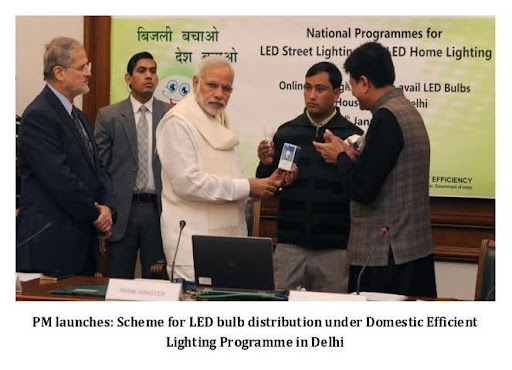
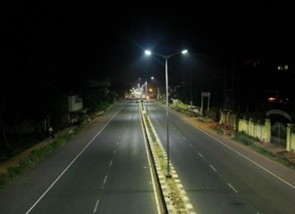
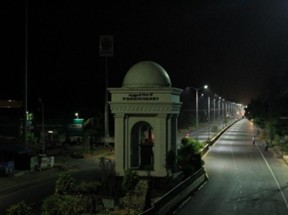
Fig 1 : Glimpses of LED Streetlights under SLNP
The following goals were set for SLNP till March 2020.
✔ Number of Streetlights to be installed (Million) : 13.4
✔ Annual Energy Saving (Million Units) : 9000
✔ Peak Demand to be avoided (MW) : 1500
✔ Annual CO2 emission reduction (Million tCO2) : 6.8
To initiate this transformation and pass on the benefits to the larger society, EESL joined hands with the ULBs, municipal bodies, and State and Central governments to implement LED streetlights with future-ready technology with an objective of :
a) Reduction in energy consumption, peak demand and costs: LED based energy efficient lighting systems consume significantly less energy which is up to 50%- 55% lower compared to the older and inefficient systems installed.
b) Optimizing Operational Performance: LED technology enables introduction of measures to optimize light sources and thereby use minimum intensity necessary to accomplish the requirement. It also can be integrated with centralized monitoring and control that could enable turning lights off using a timer when not needed.
c) Social benefits: In addition to the benefits accrued from the savings in energy there are also benefits that enhance/ improve the quality of light and thereby the safety aspects in public places.
d) Reduced operation and maintenance cost: The life of such lighting systems is longer and requires less maintenance, thereby bringing down operation as well as lifetime costs.
e) Reduced CO2 emission : Due to less grid electricity consumption, the LED technology results in mitigating climate change challenges by resulting in less CO2 emission.
The Unfolding Story
The program has seen significant successes (and challenges) in recent years. The active participation and support of ULBs, manufacturers, financial institutions (FIs), service agencies etc. have been the hallmark of SLNP. Some of the important ingredients of this national program are:
1. Access to energy efficient technology without upfront cost burden to consumers: Although there are various business models, the program generally saw a “Pay-as-You-Save (PAYS)” model. The entire upfront investment and the operating expenditures is done by EESL. The repayment to EESL by the client is done through Monthly or Quarterly Instalments as per the agreement. Typically, it is seen that the monthly/quarterly instalments paid by the user to EESL is lower than the monetized energy saved by the user during that period. The program is supported by a toll-free Complaint Handling System at national level for attending to and repairing and replacing streetlights within defined timelines.
2. Low cost of the LED lights: The high cost of LED lights was a major challenge to make the overall project viable. EESL adopted the demand aggregation approach which reduced the cost by at least 40% due to economy of scale. For example, a 110W LED fixture was priced at $ 0.6/Watt against the market price of $1.1/Watt. Such price reduction made the projects financially attractive as the benefit is passed on to the consumer.
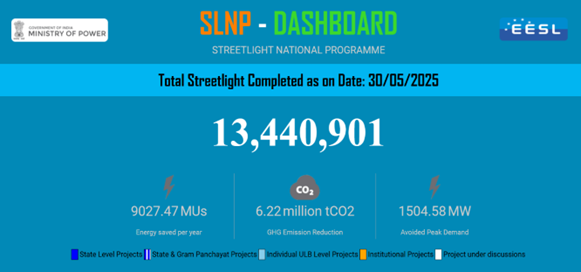
3. Public information through dashboard: The national dashboard depicts the overall and state wise LED light installations along with energy saved, peak demand reduced and estimated CO2 emission reduction. Such information backed up by transparent data provides overall technical impact of the program.
4. Smart monitoring system: Over 50% of the installed streetlights are integrated with Centralized Controlled Monitoring System (CCMS), a group control mechanism to monitor/control the operation of the lights. Such interventions not only provide effective fault detection, transparent monitoring & verification (M&V) system but also results further 5% of energy saving by curtailing unnecessary glow when daylight is available.
Although faced with challenges in demand aggregation, project implementation, payment recovery from clients, the SLNP has seen the following notable achievements :▪ Installation of 13.4 million streetlights in over 1600 ULBs in 20 states and about 13,000 Gram Panchayats in 3 states – illuminated over 300,000 km roads of India with LED lights
▪ 9 billion units (BU) of electricity saving, 1500 MW of peak demand reduction.
▪ Money saving to the tune of Rs. 5500 Cr to the ULBs in the electricity bills
▪ Increased the uptime of streetlights to more than 95%
▪ Reduction in price from Rs.180/watt to Rs.40/watt in 6 years due to bulk procurement
▪ 8-fold increment of industrial LED lights production – around 5000 per day to 40000 per day
▪ Increase of sales of streetlights from less than 1 lakh lights per month to more than 10 lakh lights per month in 6 years
▪ Social safety on roads due to better illumination
▪ Significant employment generation in the entire supply-chain eco-system
Addressing the Circularity
The circular economy is gaining importance in all sectors as it aims to minimize resource use, cut waste and reduce carbon emissions by keeping products in use for extended periods. The circular economy approach also addresses global challenges such as climate change by decoupling the economic activities from usage of finite resources. The following figure illustrates the basic principles of circular economy which integrates products, services, remanufacturing and recycling.
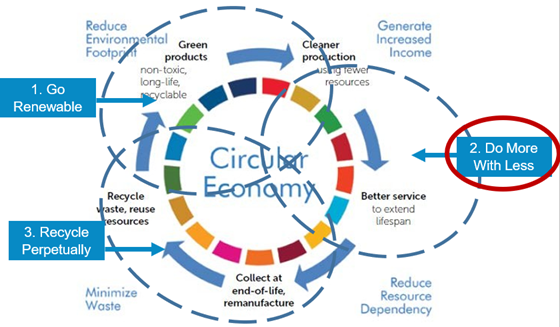
The SLNP is a classic demonstration of circularity in may senses. The LED technology provides around 4 to 5 times more life compared to conventional street lights resulting less use of materials at production over a period. It also reduces the maintenance cost to the municipalities by avoiding use of spare parts, manpower etc. Case situations in SLNP show that the municipalities and urban local bodies save around 50-60% of maintenance resources. As explained earlier, the major circularity impact of SLNP is the overall energy saving and corresponding CO2 emission reduction. The program resulted 9 BU of energy (electricity) saving per year. Considering the grid electricity dominated by fossil fuel, it is estimated that about 6.2 million tons of CO2 emission was avoided annually. This is a huge contribution to safeguard the environment and climate change. The LED production in India for streetlights is primarily based on assembling the components which are sourced from abroad. Although it is a relatively cleaner production practice, this may change in future when the indigenous manufacturing of LEDs and accessories are promoted. The local manufacturing process must follow the cleaner production and circular economy principles for multiple benefits.
The solar based streetlights integrated with battery storage system would be more attractive proposition in terms of zero CO2 emission reduction and enhanced reliability of operation. However, the cost-economics may not be suitable due to high system cost. The Atal Jyoti Yojana (AJAY) scheme of Govt. of India during 2016-22 targeted solar based LED street lights in village streets. In phase-I and II under this fully funded scheme, EESL installed around 2.72 lakh solar based LED street lights in the villages of various states impacting the rural life of people (Source: https://eeslindia.org/en/atal-jyoti-yojana/).
It is believed that a similar solution with demand aggregation approach may be adopted in urban streetlighting system in the near future. Digitalization is a key component in circular economy approach. SLNP embraced digitalization for resource optimization in program management and transparency. The smart monitoring system through CCMS resulted further energy saving by effective use of day-light, higher operational reliability (by quick fault redressals) etc. The national SLNP dashboard (https://slnp.eeslindia.org/) provides regular update about the program on total installations, national coverage, energy saving, peak demand avoidance, CO2 emission reduction etc.

The Other Big Impacts : From Darkness to Safety & Prosperity
Perhaps the most immediate and impactful change wrought by modern street lighting is the enhancement of public safety, particularly for women, vulnerable groups, and all road users. Dark, poorly lit streets are notorious hotspots for crime, harassment, and the pervasive fear that restricts movement after sunset. The SLNP saw the following big social impacts as observed through various studies and public opinions :
(i) Crime deterrent: Enhanced visibility allows for better natural surveillance – residents can see activity on the street, and individuals feel more visible themselves. Studies globally, and emerging data from Indian cities, correlate improved lighting with reductions in crimes like theft, assault, and harassment. Women report feeling significantly safer walking home from work, using public transport stops, or navigating markets at night.
(ii) Reducing Traffic Accidents: Proper street lighting is crucial for road safety. The installation of smart LED lights under SLNP has contributed to a noticeable decrease in traffic accidents, fostering safer environments for everyone. This directly supports SDG 3 (Good Health and Well-being) by reducing injuries and fatalities.
(iii) Extended Retail Hours : Shops, eateries, and street vendors feel more secure operating later into the evening when streets are well-lit. Customers are also more willing to venture out, leading to increased footfall and sales. Cities like Delhi and Mumbai have reported local businesses extending hours by 1-2 hours on average in well-lit zones, directly boosting incomes and local economic activity. A study in Delhi indicated around 24% increase in retail activity duration in areas upgraded under SLNP.
(iv) Tourism & Perception: Safer, brighter streets enhance a city’s image, making it more attractive to tourists and investors, further stimulating economic development.
(v) Technology & Innovation : The program drives the adoption of energy-efficient and smart infrastructure technologies across India, fostering domestic manufacturing and technical expertise.
Vibrant Public Spaces : Through SLNP, well-lit parks, promenades, and market squares become attractive destinations in the evening, fostering social interaction, cultural events, and recreational activities. This creates opportunities for informal vendors, performers, and event organizers, diversifying the economic base and culture.
Conclusion
The National Street Lighting Program is a classic example of curtailing energy consumption and avoiding energy wastage thereby promoting circularity in urban lives. This program is just not energy lighting upgrade, saving or cost reduction – it is a transformation. It is a powerful, multi-dimensional intervention of “Lighting the Lives” by making streets safer for citizens, invigorating local economies, slashing carbon footprints, and creating cascading benefits across the Sustainable Development Goals. By transforming the night from a time of restriction and risk into one of opportunity and activity, these luminous networks are proving to be fundamental urban infrastructure for building truly inclusive, prosperous, resilient, and sustainable cities for the future. The light they cast is indeed a beacon of progress.